
Answer a few questions below to receive a Free Business Comparative Market Analysis Report Via email.
This report will include businesses that have sold and have similar sales and Similar Business Type to yours.
Businesses that are Currently for Sale and have similar sales and Similar Business Type to yours.
Your information will remain confidential and will not be shared with anyone. Call (813) 690-0109 for a free Consultation with Vincenzo LoCricchio BCI Board Certified Licensed Business Intermediary. All inquiries are Confidential. Brokers NDA available upon request.
What Is My Business Worth? Free Florida Business Valuation Report
Free online Report showing Businesses like yours that are currently for sale and how much they have sold for!
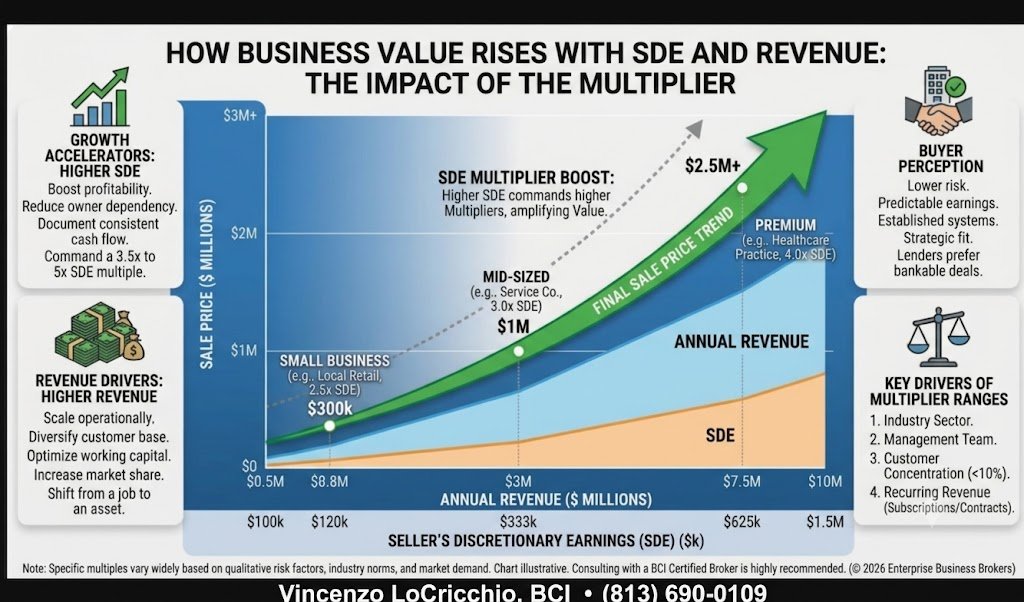
Get a Free Consultation, and a Free, No Cost, No Obligation Business Valuation Report!
Once you have your “Market Comps Report” you can decide if you want to take the next step.
The next step, the broker needs to prepare an actual business valuation. We use the most probable selling price MPSP Method. We have access to DataBases that include Tens of Thousands of Sold Businesses. We will pull the Business that are most similar to yours to come up with a market range of what your type of business is selling for in the current market place.
Items needed for the Valuation Report include;
Last 3 years Business Tax Returns
Current Year to Date P&L and Balance Sheet (same date as P&L).
Value of Business owned Tangible Assets (Furniture Fixtures & Equipment) FF&E and Intangible Assets (Franchise Agreements, Patents).
Rough inventory value of all goods for sale.
We also “shop the deal” for financing thru 3rd party lenders such as Banks and preferred SBA Lenders.
Once we review the Valuation Report and Financing options, we enter into an engagement agreement with you to confidently present your business to buyers. There is no cost or obligation on your part until we sell your business as per the engagement agreement.
Once we have the listing agreement, we market the business confidentially. See some of my personal recent Sold Businesses here.
We respond to all inquiries and have them Sign a confidentiality / non-disclosure agreement prior to disclosing any details that would give away that your business is for sale. Once we have the NDA from the buyer, we release some info on your business. We will be on all calls / phone meetings and continue to “drive the deal” until the buyer decides it’s not for them or until closing. We are engaged every step along the way.
Next Steps needed for the Valuation Report include;
1. Phone Consultation
2. Last 3 years Business Tax Returns
3. Current Year to Date P&L and Balance Sheet (same date as P&L).
4. Site visit, either before hours, after hours or on the weekend
5. Lease Terms (if applicable) Monthly Rent and Expiration Date, Lease Options?
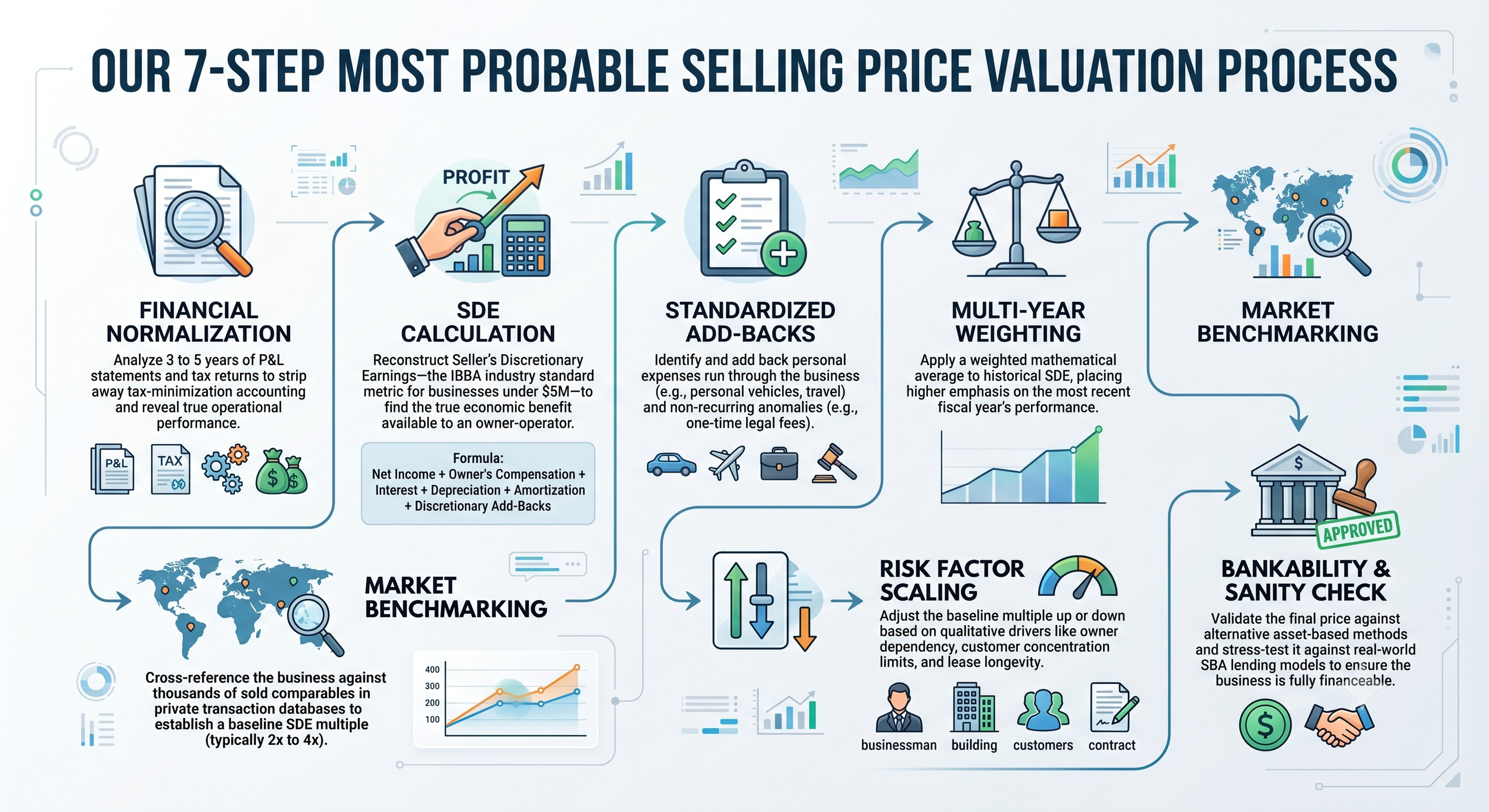
The 7-Step Most Probable Selling Price Valuation Process
1. Financial Normalization: Analyze 3 to 5 years of P&L statements and tax returns to strip away tax-minimization accounting and reveal true operational performance.
2. SDE Calculation: Reconstruct Seller’s Discretionary Earnings—the IBBA industry standard metric for businesses under $5M—to find the true economic benefit available to an owner-operator.
Formula: Net Income + Owner's Compensation + Interest + Depreciation + Amortization + Discretionary Add-Backs.
3. Standardized Add-Backs: Identify and add back personal expenses run through the business (e.g., personal vehicles, travel) and non-recurring anomalies (e.g., one-time legal fees).
4. Multi-Year Weighting: Apply a weighted mathematical average to historical SDE, placing higher emphasis on the most recent fiscal year's performance.
5. Market Benchmarking: Cross-reference the business against thousands of sold comparables in private transaction databases to establish a baseline SDE multiple (typically 2x to 4x).
6. Risk Factor Scaling: Adjust the baseline multiple up or down based on qualitative drivers like owner dependency, customer concentration limits, and lease longevity.
7. Bankability & Sanity Check: Validate the final price against alternative asset-based methods and stress-test it against real-world SBA lending models to ensure the business is fully financeable.
Small Business Valuation Methods Explained
A Comprehensive Guide to the Art and Science of Small Business Valuation Methods
Valuing a small business is often described as both an art and a science. Because small businesses aren't traded on public exchanges, their value is determined by looking at what they own, what they earn, and what the market is currently paying for similar "Main Street" companies.
Core Small Business Valuation Methods
Income-Based Approach: Focuses on the company’s ability to generate future wealth.
Capitalization of Earnings: Best for stable businesses; it takes a single period of relief (like last year’s profit) and divides it by a "cap rate" to find the total value.
Discounted Cash Flow (DCF): Best for high-growth or fluctuating businesses; it projects future cash flows and "discounts" them back to their value in today's dollars.
Seller’s Discretionary Earnings (SDE) Multiple: The gold standard for small businesses. It takes the net profit and adds back the owner’s salary, benefits, and one-time expenses, then applies an industry-specific multiplier (2 to 4 X times SDE).
Asset-Based Approach: Focuses on the "floor" value of the company’s tangible items.
Adjusted Net Asset Method: Calculates the difference between the fair market value of all assets (equipment, inventory, real estate) and all liabilities.
Liquidation Value: Determines what would be left if the business ended today and assets were sold off quickly.
Market-Based Approach: Benchmarks the business against real-world sales of similar companies.
Guideline Public Company Method: Compares the business to similar publicly traded companies (rarely used for very small businesses due to size disparity).
Direct Data Market Method: Uses databases of private sales to find "comparables" (see details below)
The Direct Market Data Method (DMDM)
The Direct Market Data Method is a specific type of market approach that relies on transaction data from private, closely-held companies rather than public stocks.
Why it is used for Owner-Operated Businesses:
Peer-to-Peer Accuracy: Most owner-operated businesses (like a local dry cleaner or a small HVAC company) have nothing in common with a multi-billion dollar public corporation. DMDM uses databases (like BizComps or DealStats) to find actual sales of similar "mom-and-pop" shops.
Reflects "SDE" Realities: Public companies use EBITDA (Earnings Before Interest, Taxes, Depreciation, and Amortization) to measure value. However, owner-operated businesses are often managed to minimize taxes. DMDM allows appraisers to see how other buyers valued the Seller's Discretionary Earnings (SDE)—the total financial benefit available to a single owner-operator.
Captures "Intangible" Local Value: This method accounts for the reality of the local market. If three bakeries in your specific city recently sold for 2.5 X times their annual SDE, that is the most "direct" evidence of what a buyer is actually willing to pay for your specific type of operation.
Simplicity for Buyers: Individual buyers of owner-operated businesses often use SBA (Small Business Administration) loans. Lenders and buyers find the DMDM intuitive because it answers the simplest question: "What did the guy down the street get for a business just like this?"
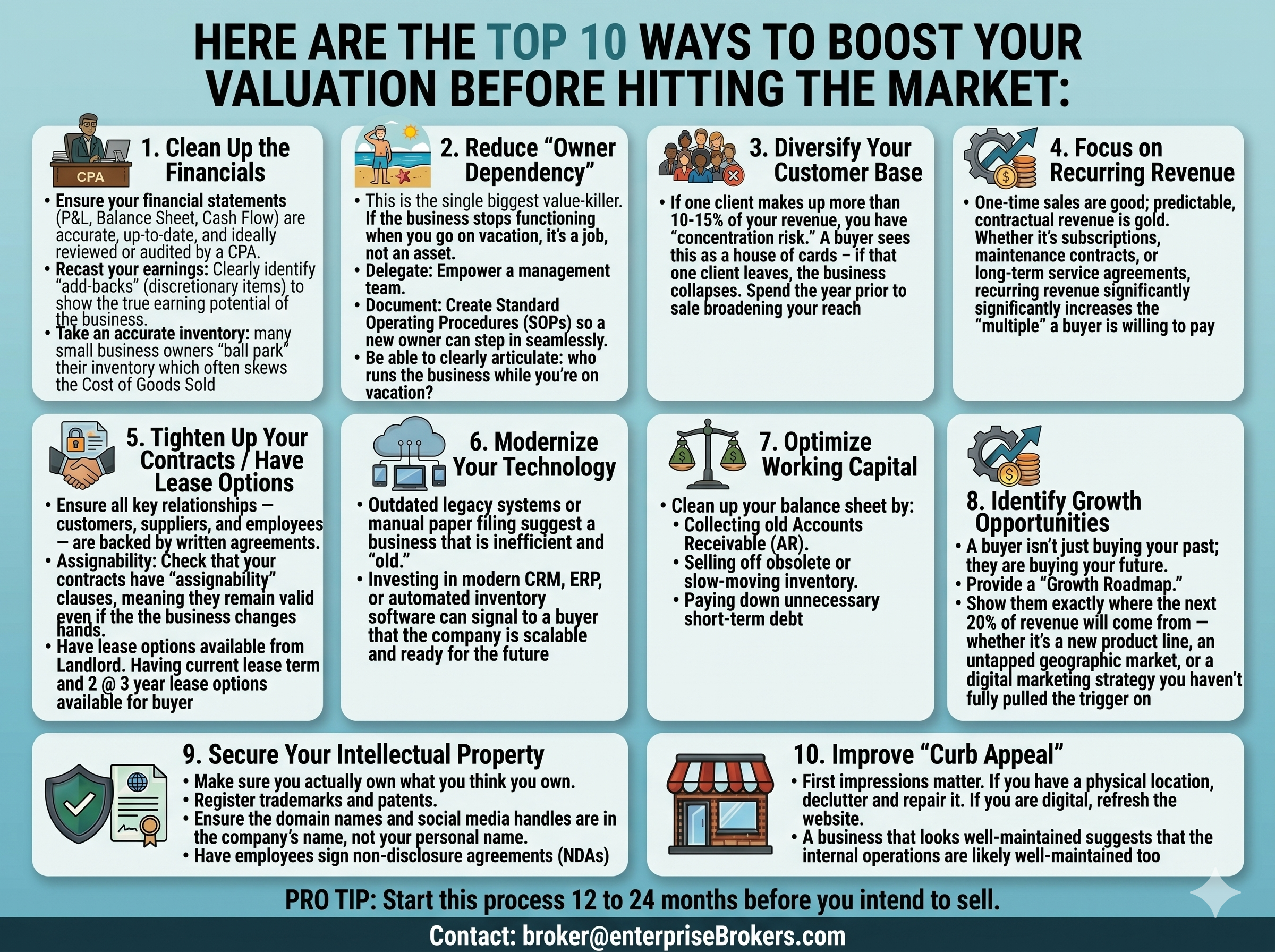
Top 10 things small business owners can do to make their business more valuable to buyers.
Selling a business is a bit like staging a house—except the "curb appeal" involves spreadsheets and systems as much as it does a fresh coat of paint. If you want a buyer to pay a premium, you need to prove that the business can thrive without you.
Here are the top 10 ways to boost your valuation before hitting the market:
1. Clean Up the Financials
Ensure your financial statements (P&L, Balance Sheet, Cash Flow) are accurate, up-to-date, and ideally reviewed or audited by a CPA.
Recast your earnings: Clearly identify "add-backs" (discretionary items) to show the true earning potential of the business.
Take an Accurate Inventory: many small business owners “ball park” their inventory which often skews the Cost of Goods Sold.
2. Reduce "Owner Dependency"
This is the single biggest value-killer. If the business stops functioning when you go on vacation, it’s a job, not an asset.
Delegate: Empower a management team.
Document: Create Standard Operating Procedures (SOPs) so a new owner can step in seamlessly.
Be able to clearly articulate: who runs the Business while you're on vacation?
3. Diversify Your Customer Base
If one client makes up more than 10–15% of your revenue, you have "concentration risk." A buyer sees this as a house of cards—if that one client leaves, the business collapses. Spend the year prior to sale broadening your reach.
4. Focus on Recurring Revenue
One-time sales are good; predictable, contractual revenue is gold. Whether it’s subscriptions, maintenance contracts, or long-term service agreements, recurring revenue significantly increases the "multiple" a buyer is willing to pay.
5. Tighten Up Your Contracts / Have Lease Options
Ensure all key relationships—customers, suppliers, and employees—are backed by written agreements.
Assignability: Check that your contracts have "assignability" clauses, meaning they remain valid even if the business changes hands.
Have Lease options available from Landlord, Having current lease term and 2 @ 5 year lease options available for buyer.
6. Modernize Your Technology
Outdated legacy systems or manual paper filing suggest a business that is inefficient and "old." Investing in modern CRM, ERP, or automated inventory software can signal to a buyer that the company is scalable and ready for the future.
7. Optimize Working Capital
Clean up your balance sheet by:
Collecting old Accounts Receivable (AR).
Selling off obsolete or slow-moving inventory.
Paying down unnecessary short-term debt.
8. Identify Growth Opportunities
A buyer isn't just buying your past; they are buying your future. Provide a "Growth Roadmap." Show them exactly where the next 20% of revenue will come from—whether it’s a new product line, an untapped geographic market, or a digital marketing strategy you haven't fully pulled the trigger on.
9. Secure Your Intellectual Property
Make sure you actually own what you think you own.
Register trademarks and patents.
Ensure the domain names and social media handles are in the company's name, not your personal name.
Have employees sign non-compete or non-disclosure agreements (NDAs).
10. Improve "Curb Appeal"
First impressions matter. If you have a physical location, declutter and repair it. If you are digital, refresh the website. A business that looks well-maintained suggests that the internal operations are likely well-maintained too.
Pro Tip: Start this process 12 to 24 months before you intend to sell. Valuation is rarely built overnight; it's the result of proving consistent, de-risked performance over time.